A supplier contract gets signed on a Thursday afternoon. Over the next month four people talk about it, and each of them has a different word for what they need from it.
The auditor wants evidence. Was the contract checked before it was signed, and who approved it? The manager wants management information: how many contracts are still waiting, and on whose desk the stuck one has been sitting since last week. The IT lead wants the logs, or just the data, because the next system has to know who handled the contract and what state it came out in. And the person who actually handled the contract calls the whole thing paperwork, the part that keeps them from the next contract.
Four words, and everyone is sure they mean something different.
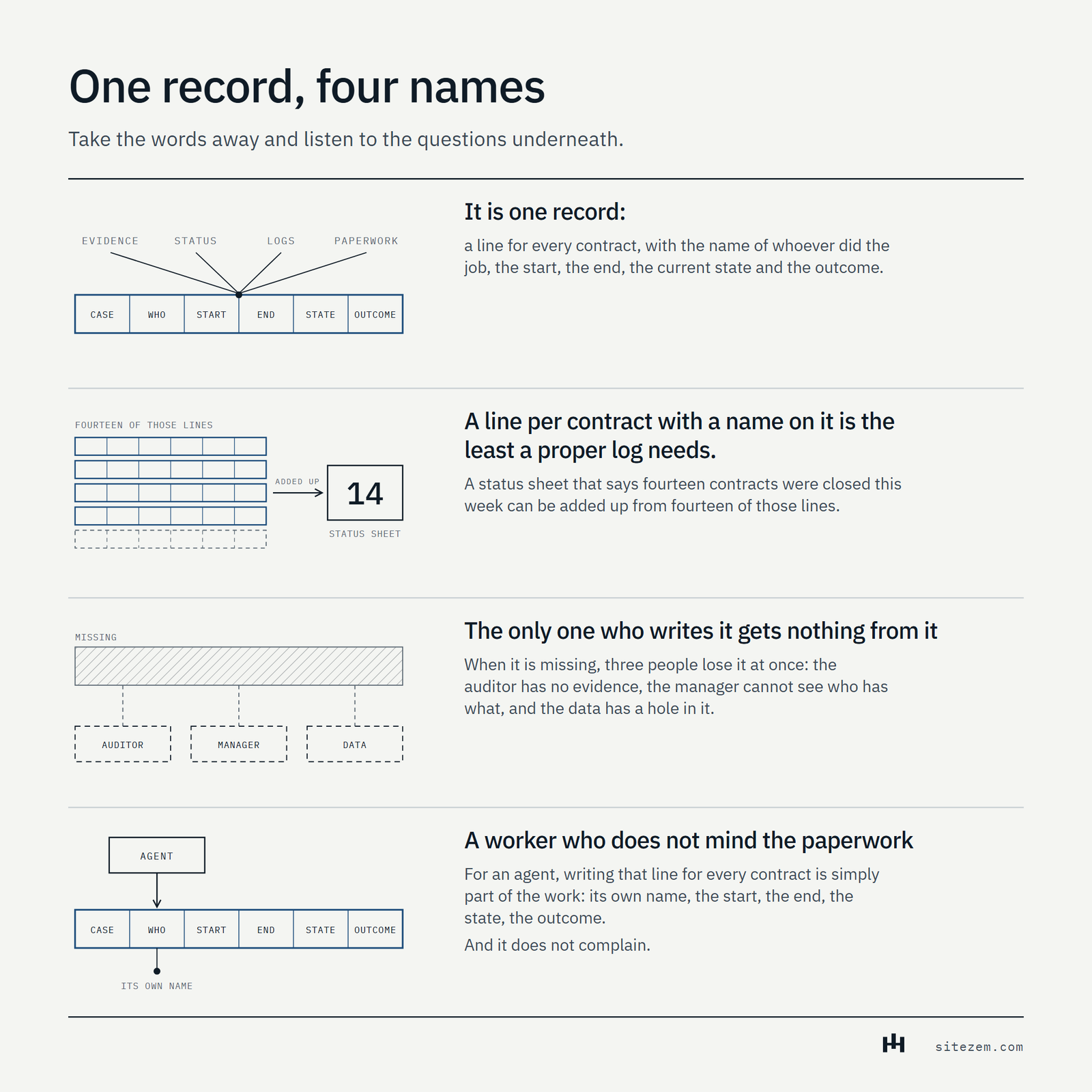
Take the words away and listen to the questions underneath. Which contract, and who did the job? When did it start, and when did it end? Where is it now, and what came out of it? The auditor is asking exactly that, and so is the manager. The IT lead asks the same with a different word on top. It is one record: a line for every contract, with the name of whoever did the job, the start, the end, the current state and the outcome. Legal calls it evidence, or the audit trail. In business it is management information when a manager wants it and paperwork when somebody has to write it down. Data-IT calls it logs.
A line per contract with a name on it is the least a proper log needs. A status sheet that says fourteen contracts were closed this week can be added up from fourteen of those lines. It cannot be taken apart again to show who closed which one, or which one sat waiting for nine days, and that is the next thing both the auditor and the manager will ask.
Because the names differ, each language asks for the record separately. The compliance checklist has a box for the date the review started. The weekly status sheet has a column for it. The contract system has a field the IT team added last year. Same date, typed in three places by the same person, usually on different days. Not always as the same number, either. Nobody designed it that way. Each department wrote down what it needed in its own words, and nobody in the room noticed that the others were asking for the same thing.
The only one who writes it gets nothing from it
So who does the typing? The person who handled the contract, and they have a point. Who cares about marking things done? Doing is what brings value. You hear some version of that in any team that does the actual work, and from where they sit it is true. Writing down when a contract started does not get the contract signed. The value of the record lands with people the doer rarely sees, and the cost lands on the doer, every time, at the exact moment they would rather start the next one.
So managers push and the people doing the work push back, and honestly both are being reasonable. The marking slips. It gets done on Friday, about Tuesday, from memory. Or the week before the audit. What the argument hides is how much rides on that one record. When it is missing, three people lose it at once: the auditor has no evidence, the manager cannot see who has what, and the data has a hole in it. It looks like a fight about paperwork. It is a fight about the one thing all three languages depend on.
A worker who does not mind the paperwork
Now hand the doing to an AI agent.
I have built agents for my own frogs, as I call them, the administrative jobs nobody wants to start the day with: documents, collecting information, checking, re-checking. Not one of them has ever told me that doing is what brings value. For an agent, writing that line for every contract is simply part of the work: its own name, the start, the end, the state, the outcome. It has no next contract it would rather be starting, and it does not catch up on Friday from memory. It writes the line when the thing happens, every time. And it does not complain.
The name on the line matters more now than it did before. Some contracts will be done by people and some by the agent, and the first thing the auditor asks is which.
And that record is the evidence. It is the management information and the log as well. Nobody has to ask for it three times, because there was only ever one thing to ask for. The oldest argument between managers and the people doing the work goes quiet on the day the doing moves to something that does not mind the paperwork.
That changes the question. For years it was how to get people to fill the record in. Once an agent fills it in, the question is what you do with it, and that one is a lot more interesting than the paperwork ever was.
Before you hand a process to an agent, try this. Ask your auditor, the manager who reports on it and your IT lead what each of them needs to see once the work is done. Write their answers down in their own words. Then cross out the words and compare what is left.