You handed your work off – a deliverable, a service, a product – and somehow it keeps coming back. A file returns with half its fields empty. A question opens with “we assumed you would still…” A deadline slips because nobody was sure whose week it was.
Now stand on the other side of it. The team or client that took it on sees the mirror image: inputs that arrive incomplete, a scope that quietly grew in week three, blame for gaps they were never told to fill. Each side is certain the other one dropped it. Each side is half right.
Here is what actually happened. You delivered a result built on assumptions nobody put into words. So acceptance becomes a negotiation all over again at every handoff – and the gaps you never settled harden into the conflict, delay, and rework you pay for each time. You didn’t skip a conversation. You signed up for a permanent one.
Every Handover Has Two Sides of a Table
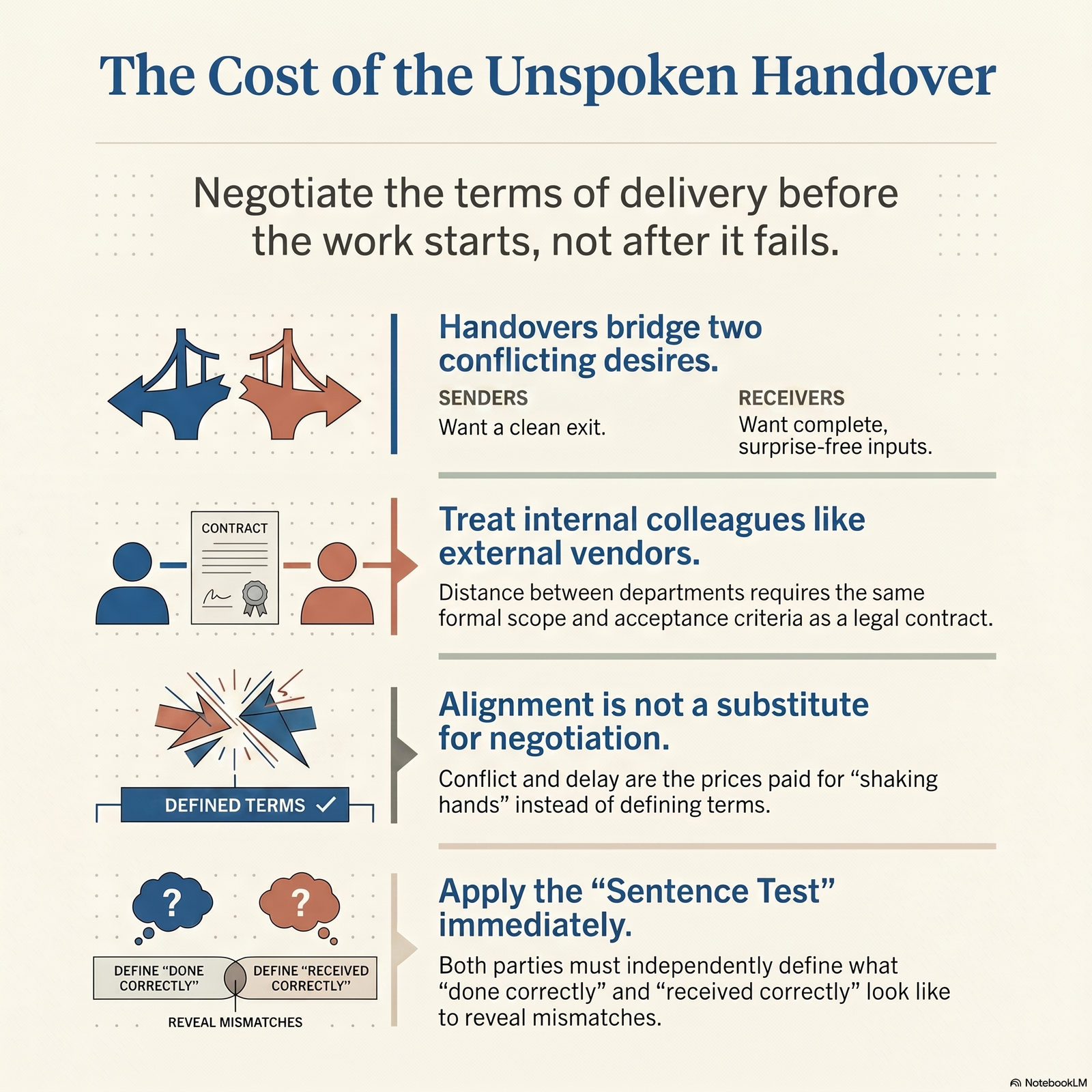
The negotiation should begin before you produce anything – not at the moment you deliver it. It begins because two parties want different things, and both are right to.
Neither position is wrong. They are simply not the same, and the distance between them is what a handover exists to close. Closing it means agreeing the terms – the things both sides assume and neither says out loud:
- What moves across, and in what condition.
- What “complete” means before the work is allowed to leave one side.
- By when, and on whose clock.
- How the receiver confirms they got what they actually needed – not merely that something arrived.
That is the deal. Leave it off the table, and each side quietly writes its own version – then assumes the other one signed it.
We Sign Contracts With Vendors and Shake Hands With Colleagues
Hand a function to an outside supplier and the instinct kicks in on its own. You scope it. You write acceptance criteria. You argue over who covers what when something breaks. The negotiation happens because the line between two companies is visible – nobody pretends a contract isn’t needed.
Move the same handover one floor down, between two of your own departments, and the instinct vanishes.
It doesn’t. The internal boundary is just as real – it is only harder to see. And the cost of leaving it unsettled is the same on either side of the wall:
People skip the conversation because it forces disagreement into the open while everyone is still being agreeable. Inside one company, that pull is even stronger – raising terms with a colleague feels like distrust. It isn’t. It is the cheapest version of a talk you will otherwise have later.
The Sentence Test
Take any handover you have made – to a supplier, or to the next desk over. Ask the person who sends and the person who receives to write down, separately, one sentence: what does “done correctly and received correctly” look like?
- If the two sentences match, you negotiated the handover, whether you called it that or not.
- If they don’t – and they usually don’t – you didn’t transfer the work. You transferred a disagreement that simply hasn’t surfaced yet.
Two matching sentences before the handshake cost you one awkward afternoon. Two mismatched ones, found through a returned file in week three, cost you that same afternoon anyway – now with a broken deliverable on the table, a deadline already gone, and each side sure it was the other’s job. The negotiation happens either way. The only choice is whether you hold it while it is still cheap.