You approved the strategic plan three months ago. New direction, clear goals, board sign-off. And yet the Monday morning after the offsite looks exactly like the Monday morning before it. The same reports in the same inboxes. The same friction between departments. The same question from the board next quarter: “Why hasn’t anything moved?”
Because a plan isn’t a strategy. A strategy is a choice – what you’re going after, what you’re giving up to go after it, and an honest look at whether your organization can actually pull it off. The plan on the wall skipped at least one of those.
Choosing Is the Hard Part
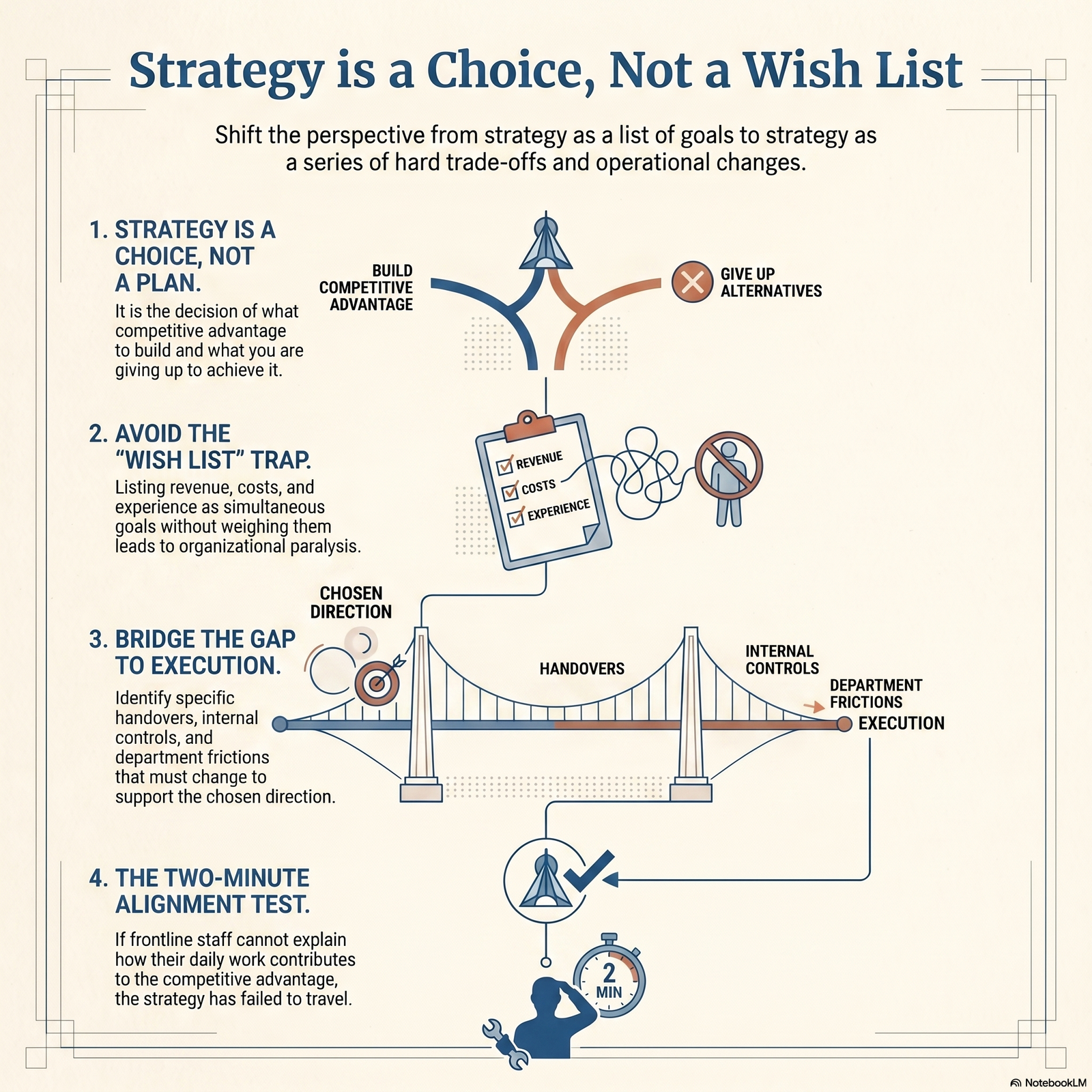
Strategy starts with alternatives. Not “what do we want” – every organization wants growth, efficiency, happy clients. The question is: which competitive advantage are you building, and why this one over the others?
It could be entering a new market where your current capabilities give you an edge nobody else has. It could be a product that changes the unit economics of your sector. It could be fixing something so broken internally that survival depends on finding the root cause before the next audit cycle. These are fundamentally different directions, and they demand fundamentally different actions from the organization.
Most strategic plans I’ve seen skip this step. They list goals without weighing them against each other. Grow revenue and cut costs and improve client experience and enter a new market – all at the same time, with the same people, on the same budget. That’s not strategy. That’s a wish list distributed across departments, where everyone picks the goal closest to their own function and ignores the rest.
The moment you choose one direction over another, something uncomfortable happens: the alternatives you didn’t choose become visible as things you’re not doing. And that visibility is exactly what most leadership teams avoid.
From Direction to Action – the Gap Nobody Plans For
Suppose the choice is made. Let’s say the competitive advantage is speed – getting clients from first contact to active service faster than anyone in the market. Clear direction.
Now the real question: what in the organization actually needs to change to make that happen?
This is where most strategies stall. The direction is clear, but nobody translates it into specific changes. Which departments are involved in the client journey? Where does information pass from one team to another, and what breaks at those handovers? Which steps in the current flow exist for the client’s benefit and which exist only for internal control? Are those control steps still necessary, or are some left over from requirements that no longer apply?
These aren’t process improvement questions. They’re strategic questions – because if you can’t answer them, the direction you chose has no path to execution. The competitive advantage stays theoretical.
I’ve watched this gap across satellite companies, government IT, fintech, data centers. The board picks the direction. Then the organization keeps running the way it always has, because nobody connected the direction to the specific things that need to change – and in what order.
The Test That Takes Two Minutes
Ask anyone in your organization – not the leadership, not the managers, but the person handling client files or running daily operations – one question: What competitive advantage is the organization building right now, and how does your work contribute to it?
If they describe something that matches the strategic plan, the strategy is alive. If they look confused, the plan hasn’t reached them.
The interesting part is not the confusion itself – it’s where in the organization the confusion starts. That tells you exactly how far the strategy traveled before it stopped. But figuring out what to do about that distance, and in what sequence – that’s where it stops being a plan and starts being actual strategic work.